Keep what works. Change what doesn't.
We modernise legacy products and workflows without forcing the business into a risky big-bang replacement. The improvements happen in stages, while your business keeps running.
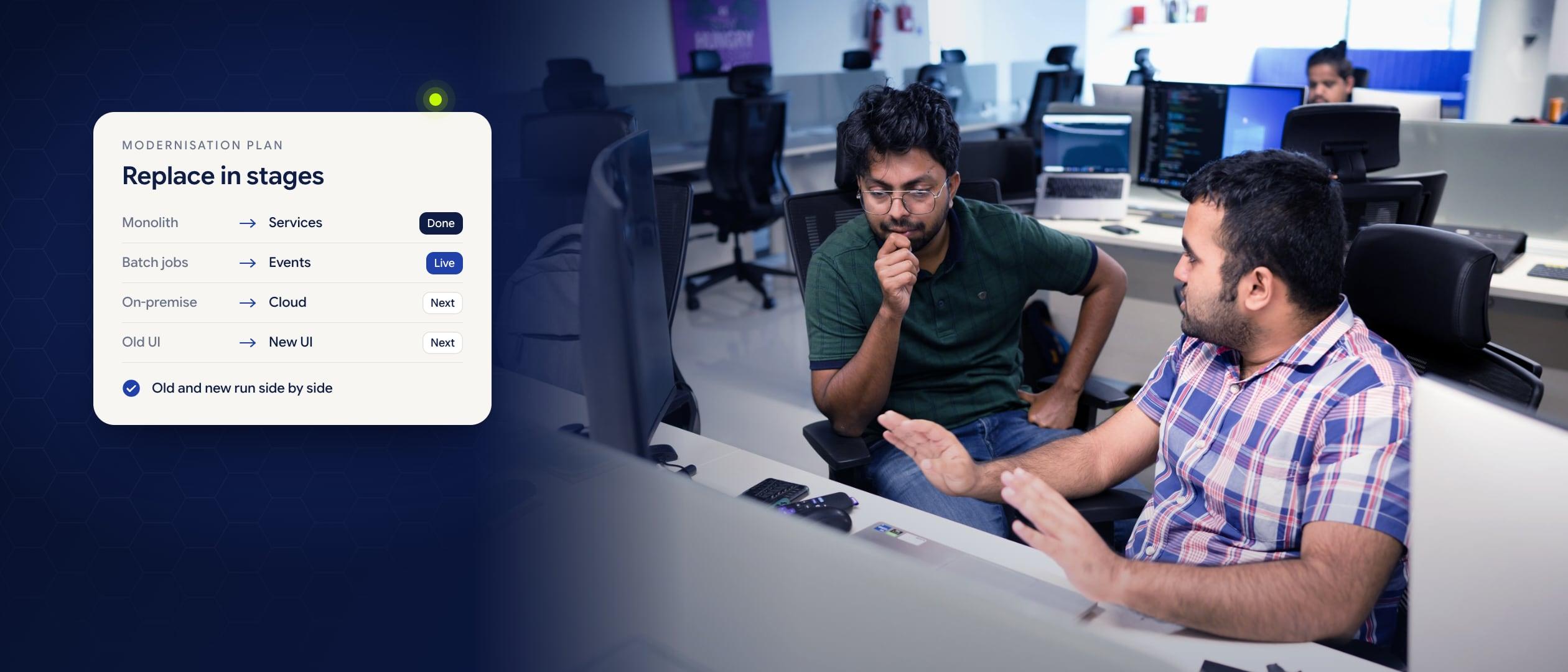
Overview
Modernise without stopping the business.
Legacy systems are usually legacy because they work. They hold years of business logic, data and customer trust. Replacing everything at once is expensive and risky and often fails. We take a different route: understand what you have, keep what still serves you, and modernise the parts holding you back one step at a time, with old and new running side by side until each change has proved itself.
- What it solves
- Your product works, but legacy technology, disconnected workflows or technical debt are slowing the business down. Releases may be slow and risky, the technology hard to hire for, the experience dated, the systems disconnected, or critical processes still running on spreadsheets.
- What we do
- We modernise in stages, keep old and new working together where needed, and reduce migration risk. Each stage delivers value on its own, so you see improvements early rather than waiting for one big launch.
- What you get
- An assessment of your current product, a modernisation roadmap, re-platforming of the parts that need it, and an incremental migration plan for data, users and workflows.
What you get
Four steps from legacy to modern.
Assessment
A clear review of your current product: code, architecture, infrastructure, data, user experience and the workflows around it. We identify what's working, what's risky and what's costing you most, and summarise it in plain language for both technical and business teams.
Modernisation roadmap
A staged plan that sequences the work by business value and risk, with the highest-impact, lowest-risk changes first. Each stage has clear outcomes, cost and timing, so you can fund and approve modernisation one step at a time.
Re-platforming
Moving the parts that need it to modern technology. That might be a new architecture, modern frameworks, a refreshed user experience, cloud infrastructure or AI-enabled features. We keep the business logic and data that matter, and rebuild what holds the product back.
Incremental migration
Moving users, data and workflows across gradually, running old and new side by side where needed, with testing and rollback at every step. The business keeps operating while the product changes.
Our approach
Four steps, no big bang.
- Step 01
Assess
We review the product, its technology and the workflows around it, and talk to the people who use and maintain it. We agree what modernisation must achieve, such as speed, cost, scalability, security or experience, and how we'll measure it.
- Step 02
Prioritise
We decide what to keep, what to improve and what to replace, and in what order. High-value, low-risk changes come first, so the business sees results early and confidence grows with each stage.
- Step 03
Modernise
We rebuild and re-platform in small, production-ready increments, with design, engineering and cloud working as one team. Each piece is tested against the existing system before it takes over.
- Step 04
Transition
We move users, data and workflows over in stages, monitor closely and keep fallback options until each change is proven. When the old parts are no longer needed, we retire them cleanly.
What we modernise
From spreadsheets to platforms, and legacy to cloud.
Spreadsheet-driven processes
Critical operations such as lending, ordering and reporting moved from manual spreadsheets into secure, automated platforms with role-based access.
Ageing applications
Web and mobile products rebuilt on modern frameworks, with improved performance and usability, often without changing what users rely on.
Legacy infrastructure
Applications moved from ageing servers and shared hosting to scalable cloud platforms such as AWS and Microsoft Azure.
Dated experiences
Interfaces redesigned and design systems introduced, so long-running products feel consistent and current again.
Disconnected systems
Tools, portals and data sources brought into one connected platform through APIs and integrations.
AI-ready foundations
Modernised data and architecture that make it practical to add AI features and automation.
Where it fits
Discover · Design · Build · Scale
Every engagement can move through four stages: Discover, Design, Build and Scale. Product modernisation covers all four. In Discover, we assess and plan. In Design, we reshape the experience. In Build, we re-platform and migrate. In Scale, we grow the modernised product. The same team carries the work through every stage.
- 01Discover (this service)
- 02Design (this service)
- 03Build (this service)
- 04Scale (this service)
Why Codezyng
One team for every part of modernisation.
Modernisation needs product strategy, design, engineering, cloud and AI working together, and we cover them all in one accountable team. We've moved businesses off spreadsheets and onto platforms, migrated live products between cloud providers, and improved long-running apps without disrupting their users. As an ISO/IEC 27001:2022 certified company, we protect your data at every stage of the move.
Low-risk by design
Staged change, side-by-side running and rollback plans.
Value at every stage
Each step delivers improvements on its own.
Transparent collaboration
Honest estimates, open tools, no surprises.
Long-term partnership
We're still here long after the migration.
Questions
What buyers ask
Get started
Let's build what's next.
Is your product holding the business back? Tell us what's slowing you down, and we'll show you a step-by-step way forward that keeps the business running.